 EN
EN

Understand Wastewater Core Properties as Selection Foundation
Many project operators rush to lock DAF equipment models before collecting complete wastewater testing data, which leads to unstable outlet water and extra transformation costs within one to two years of operation. As global wastewater treatment technical standards ISO 13443 and GB/T 12138 clearly state, detailed water quality testing acts as the non negotiable starting point of DAF system selection. Operators need to record stable values and peak fluctuation range of suspended solids, oil and grease concentration, pH value and hourly water flow. A real cooperation case with Bangladesh Mahadi Company in April 2026 fully proves this point. The livestock breeding enterprise originally planned to buy a small standard DAF unit without sampling test, but field inspection found its peak suspended solid concentration exceeded conventional parameters by forty percent. If the original model was put into use, the solid liquid separation efficiency would drop below sixty percent during breeding peak period. Professional technical teams suggest reserving twenty percent extra processing margin on the basis of maximum hourly water flow to cope with daily and seasonal water quality changes.
Master Core Technical Parameters to Match DAF Processing Capacity
Familiarity with four core technical indicators helps buyers avoid over investment or insufficient processing capacity when comparing DAF systems. The first indicator is surface load, with 5 to 8 cubic meters per square meter per hour suitable for general municipal sewage, while oily wastewater from food factories needs to lower the standard to 3 to 5 cubic meters per square meter. The second key value is air solid ratio, which stays between 0.01 and 0.03 for common suspended solid removal and rises to 0.03 to 0.06 for high oil containing wastewater. Dissolved air reflux ratio stands as the third critical parameter, controlled at twenty to thirty percent for most industrial scenarios, and adjusted to forty to fifty percent for high concentration breeding wastewater. The fourth factor is microbubble diameter, and qualified DAF release devices can generate bubbles under thirty micrometers to fully capture tiny flocs. For a food processing plant with peak water flow of ninety cubic meters per hour, engineers calculate effective separation area through surface load formula and select a DAF unit with fourteen square meters separation zone to keep stable operation under fluctuating water volume.
Match DAF Configuration and Material Based on Industry Operation Scenarios
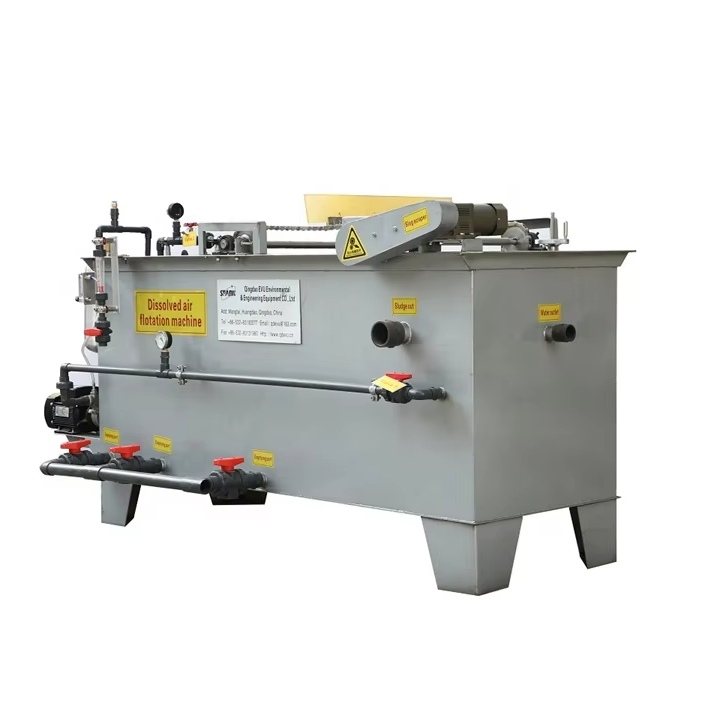
Different industries carry unique wastewater pollution characteristics, requiring targeted DAF material and accessory configuration to extend service life and cut maintenance frequency. Food and beverage wastewater contains plenty of grease and protein residues, so main tank body made of 304 stainless steel is recommended to resist corrosion from organic acid substances, matched with anti adhesion chain slag scraping mechanism. Livestock farming wastewater features high salt and high suspended solid content, which needs 316L stainless steel for contact parts and supporting automatic PAM dosing machine to achieve uniform flocculation reaction before air flotation. Municipal sewage treatment projects with medium pollution concentration can choose carbon steel with anti rust coating to balance initial investment and operation performance. Small scale intermittent discharge workshops can pick compact integrated DAF, while large continuous production factories need split type large flow DAF with independent dissolved air tank to reduce equipment load during long hour running.
Evaluate Automatic Control and Auxiliary System to Cut Long Term Operating Cost
Initial purchase cost only accounts for thirty percent of the whole life cycle expenditure of DAF equipment, while chemical consumption, electricity bill and manual maintenance dominate long term operation expenses. Fully automatic DAF systems equipped with PLC intelligent control modules bring obvious cost advantages compared with semi manual equipment. The integrated control system can dynamically adjust dissolved air pressure, chemical dosing volume and slag scraping frequency according to real time inlet water quality, lowering PAM and PAC consumption by fifteen percent on average from thousands of installed project data. Supporting automatic dosing machine realizes unattended medicament mixing and feeding, removing the need for full time staff to operate dosing tanks every day. Standard automatic DAF units also install self flushing pipelines for release devices, cutting weekly manual cleaning work and reducing equipment failure rate by nearly ninety percent, which creates obvious economic benefits for factories with limited on site labor allocation.
Avoid Common Selection Pitfalls That Cause Post Operation Failure
Technical teams with over ten years of water treatment equipment manufacturing experience summarize three universal selection mistakes that repeatedly trigger post delivery operation troubles. The first mistake ignores peak water flow margin and only selects DAF based on average daily water volume, leading to overflow and incomplete separation during production rush hours. The second error sets fixed reflux ratio without distinguishing wastewater types, resulting in either insufficient bubbles to capture pollutants or excessive power waste from high reflux proportion. The third trap chooses low cost inferior release devices to save upfront cost, which get blocked by grease and fiber residues within three months and require frequent disassembly and replacement. Professional suppliers will provide complete equipment parameter test reports before order confirmation, verifying bubble uniformity, dissolved air efficiency and material anti corrosion performance to eliminate hidden operation risks in advance.
Select Qualified Manufacturer with Complete Manufacturing and Global Service Capacity
Even the most accurate DAF selection scheme cannot reach expected processing effect without stable manufacturing capacity and comprehensive after sales support. Reliable DAF suppliers need to own independent workshop production lines covering whole wastewater treatment equipment series, complete quality inspection procedures and mature overseas project service experience. QDEVU, founded in 1999 with over ten years of dedicated water treatment equipment manufacturing, owns a production base over one thousand square meters and provides installed equipment for more than one thousand projects across over fifty countries and regions. The brand can independently finish DAF body manufacturing, automatic dosing system matching and intelligent control program development, supporting fully customized DAF structure, material and processing capacity according to different industry overseas project standards. Its global after sales team offers on site installation commissioning, staff operation training and long distance technical guidance for all exported DAF units, solving equipment debugging and maintenance problems for cross border customers efficiently without delayed project progress.
Table of Contents
- Understand Wastewater Core Properties as Selection Foundation
- Master Core Technical Parameters to Match DAF Processing Capacity
- Match DAF Configuration and Material Based on Industry Operation Scenarios
- Evaluate Automatic Control and Auxiliary System to Cut Long Term Operating Cost
- Avoid Common Selection Pitfalls That Cause Post Operation Failure
- Select Qualified Manufacturer with Complete Manufacturing and Global Service Capacity