 EN
EN

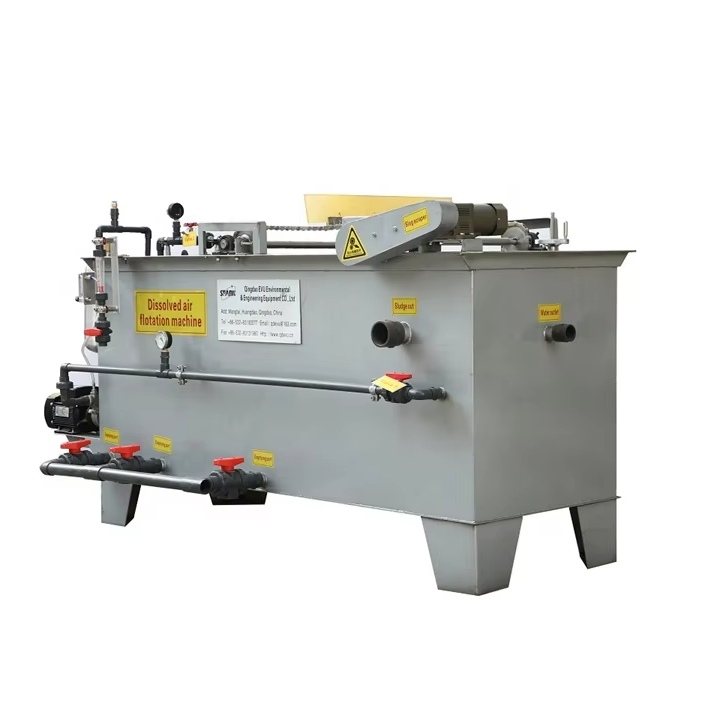
Overcoming Operational Headaches in High Rate Facilities
If you have ever managed a sedimentation basin during a seasonal algae bloom, you understand the sinking feeling of watching a pristine settling tank suddenly turn into a green, turbid overflow. Traditional sedimentation relies heavily on the specific gravity of particles. The problem is that many of the most troublesome contaminants in modern water treatment such as algae, low density color causing organics, and light flocculated solids simply refuse to sink at a commercially viable pace. Dissolved Air Flotation, or DAF, flips this problem on its head by introducing a cloud of micron sized air bubbles that attach to these stubborn particles, lifting them to the surface for mechanical removal. The difference in operational stability is stark. While a sedimentation basin often requires careful thermal management to avoid density currents that short circuit the flow, a well designed DAF unit maintains a stable stratification layer regardless of minor temperature shifts, ensuring that biological upsets do not automatically translate into compliance violations.
The Physics of Separation Speed and Surface Loading
To truly grasp why DAF offers a massive leap in efficiency, one must look at the fundamental physics governing gravity separation. In a sedimentation tank, you are essentially waiting for a particle to fall through a liquid column according to Stokes’ Law, a path that can take hours depending on the density differential. DAF alters this dynamic entirely. By dissolving air into a saturated sidestream and releasing it through a pressure drop, you create bubbles typically ranging from ten to one hundred microns. When these micro-bubbles attach to a solid, the effective buoyancy is dramatically increased, giving the aggregate a rise rate that is often several orders of magnitude faster than its settling velocity. This allows a DAF system to operate at a surface loading rate that can exceed ten meters per hour, a value that would wash out a conventional clarifier almost immediately. The direct result of this elevated hydraulic rate is a basin that occupies a fraction of the footprint, slashing civil engineering costs and making retrofits inside existing buildings a viable option.
Superior Clarification Through Microbubble Adhesion
The clarifying power of DAF goes beyond just speed; it touches on the quality of the separation itself. In a traditional clarifier, the sludge blanket is a dense, fluidized zone at the bottom. As particles settle, they entrain significant amounts of free water, resulting in a sludge that typically needs further thickening before dewatering. DAF creates a floating sludge blanket that is fundamentally different. As the bubbles continue to lift off the water surface under constant pressure, they actually partially drain the sludge layer from below. You can observe this at any operating DAF plant; the floated solids sit on top of the water column, compressing under their own weight while the bubbles pop, yielding a sludge consistency often reaching three to five percent dry solids directly off the surface. This inherent thickening capability offloads the downstream equipment and can significantly reduce the polymer dosage needed for dewatering. For operators, this means less time managing sludge pumps and more stable solids inventory in the biological reactors.
An Engineering Response to Changing Raw Water Characteristics
The engineering community widely recognizes that raw water sources globally are trending toward lower turbidity but higher concentrations of dissolved organic carbon and biological activity. Traditional sedimentation, designed primarily for settling heavier inorganic silts, is often chemically overloaded in these scenarios. The coagulant demand to weigh down light, organic floc can be prohibitive. DAF is not just an alternative here; it is the rationally engineered response. By targeting the air to adhere to the hydrophobic surfaces of algae cells or the micro-flocs formed by color removal, DAF achieves a degree of clarification that sedimentation would require lamella plates or tube settlers to even attempt, and even then, performance often lags during cold water periods when viscosity increases. The reliance on bubble attachment rather than gravity alone makes the process remarkably indifferent to the low water temperatures that typically cripple settling basins by increasing water viscosity and slowing particle descent.
Lowering the Total Cost of Ownership Through Chemistry and Energy Synergy
A transparent discussion of DAF must acknowledge that it requires energy to compress air, a variable that is sometimes used to argue against it. However, a holistic look at the total cost of ownership reveals a more nuanced picture. The high surface loading rates mean the DAF tank itself is significantly smaller. This miniaturization reduces the embodied carbon in the concrete and steel, and in many cases, allows for a fully enclosed, shop fabricated unit that avoids weather related construction delays. More importantly, the chemistry leans out. Because you are not trying to weight down the floc to sink, the coagulant dose often drops measurably compared to an equivalent sedimentation process. Less chemical sludge is produced, which directly cuts disposal costs. QDEVU has observed through numerous client interactions that the return on investment calculation often shifts favorably once the combined savings in civils, chemicals, and sludge handling are mapped against the marginal increase in electrical load for the air compressor and pump system.
Turning Engineering Insight Into Project Certainty
Selecting a DAF system is not just a technical exercise; it is a procurement decision that impacts project timelines and long term operational reliability. A DAF unit is a precision fabricated assembly where the quality of the pressure vessel, the mechanism of the surface skimmer, and the non clogging design of the bottom settled solids removal are critical. This is where the manufacturing quality and supply chain control of the provider become paramount. When the entire process, from plate rolling to welding and controls programming, is managed under a single roof, the risk of interface errors between the saturator and the flotation tank disappears. QDEVU delivers this integrated assurance, ensuring that the theoretical benefits of high rate clarification translate seamlessly into physical equipment that performs from the moment of commissioning. A manufacturer with direct control over fabrication quality guarantees that the tailored engineering solutions will withstand the rigors of industrial wastewater or municipal drinking water treatment without early life failures.
Table of Contents
- Overcoming Operational Headaches in High Rate Facilities
- The Physics of Separation Speed and Surface Loading
- Superior Clarification Through Microbubble Adhesion
- An Engineering Response to Changing Raw Water Characteristics
- Lowering the Total Cost of Ownership Through Chemistry and Energy Synergy
- Turning Engineering Insight Into Project Certainty