 EN
EN
The Hidden Cost of Waiting for Gravity to Work
Every wastewater operator has experienced that moment of quiet panic when a secondary clarifier begins to show signs of a sludge blanket rising. You might see clumps of biologically active solids, carried not by the underflow but by tiny nitrogen gas bubbles produced in the anoxic zone of the blanket itself, floating up and cascading over the weirs. This is the fundamental limitation of traditional sedimentation: it is a passive process. You are essentially waiting for gravity to convince light, often biologically active flocs to sink. Dissolved Air Flotation, or DAF, eliminates this waiting game by introducing a dense cloud of micro bubbles directly into the liquid stream. Instead of relying on gravity and chance, operators shift to a proactive separation mode where solids are actively lifted to the surface. The result is a solids removal process that is governed by hydraulic design, not by the unpredictable settling characteristics of a biological culture that can change hour by hour.
Why Floating Sludge Outperforms Settled Sludge
To understand the efficiency leap, one must look closely at what happens to the solids after they are separated. In a gravity thickener or clarifier, settled sludge forms a blanket at the bottom that continues to entrain massive amounts of free water. Achieving a sludge concentration of even two percent can be a struggle without extended detention times. DAF fundamentally flips this dynamic. When the micro bubbles attach to a solid and carry it to the surface, they create a floating sludge layer that undergoes a natural dewatering process. As those bubbles begin to pop and the water within the sludge mat drains back down through the liquid column, the floating solids compress under their own weight. You can observe this at any well operated DAF plant: the top of the floated sludge can look almost dry while the bottom of the layer remains moist. This self compressing action routinely produces a sludge consistency that is significantly thicker than what comes off the bottom of a sedimentation basin, which translates directly into fewer truckloads for disposal, less filtrate to re treat, and a dramatic drop in the volume loading on downstream dewatering equipment.
Capturing the Uncatchable Particles
A sedimentation tank works well for heavy, dense grit. It often fails miserably at capturing what operators call the “pin floc,” those tiny, feathery aggregates that stay in suspension almost indefinitely. These particles represent a direct loss of treatment efficiency and a major headache if the plant discharges to a sensitive water body or feeds a tertiary membrane system. DAF machines excel precisely because they target these difficult fractions. The micro bubbles do not care how heavy a particle is; they attach based on surface charge and hydrophobic interactions. Grease, fats, and oils that would otherwise form a floating scum or pass through a clarifier are immediately captured and concentrated. The resulting effluent from a DAF unit is frequently polished to a degree that can extend the life of membrane filters downstream by orders of magnitude, reducing chemical cleanings and preserving the integrity of expensive ultrafiltration or reverse osmosis systems. This ability to remove what gravity simply refuses to catch is where DAF proves its worth as a water quality barrier.
A Response to the Biological Nutrient Removal Trend
The environmental engineering sector has largely moved toward biological nutrient removal processes that rely on long sludge ages and specific anaerobic and anoxic zones. While these processes are brilliant at removing nitrogen and phosphorus, they produce a type of biological floc that is notoriously light and prone to bulking. Traditional design manuals have long suggested that for activated sludge plants experiencing persistent settleability issues, dissolved air flotation is not just an alternative but often the preferred method of clarification. This is not a niche opinion but a widely recognized design philosophy in regions where strict effluent phosphorus limits are enforced. When a treatment facility adopts enhanced biological phosphorus removal, the phosphorus accumulating organisms tend to hold the biomass in a lighter, more buoyant state. Trying to settle this biomass quickly in a secondary clarifier can feel like a losing battle. DAF sidesteps the entire issue by not asking the biomass to sink, making it a resilient engineering response to the evolving complexity of modern wastewater treatment flowsheets.
Reducing Polymer Reliance and Building Process Stability
A transparent conversation about sludge handling must include the chemical budget. Gravity belt thickeners and centrifuges are effective tools, but they often demand substantial polymer conditioning to release interstitial water. A DAF sludge blanket, leveraging the physical action of bubble compression and drainage, can often achieve equivalent or better thickening with a markedly lower polymer dose. This is not just a chemical cost saving; it also eliminates the risk of over dosing polymer that could circulate back through the plant's headworks and foul downstream treatment units. Beyond chemistry, the process resilience of DAF is a defining feature. A sudden increase in hydraulic flow that would wash a settling sludge blanket right out of the basin is managed much more gracefully in a DAF unit because the separation relies on bubble attachment rather than quiescent settling time. The system tolerates thermal inversions and density currents that would otherwise cause catastrophic short circuiting in a conventional sedimentation tank, making it a reliable anchor in an unpredictable treatment environment. Naturally, this performance requires clean maintenance of the air saturation system and the periodic replacement of wearing parts, but the trade off in stability is almost always worth the effort.
From Process Design to Fabricated Reality
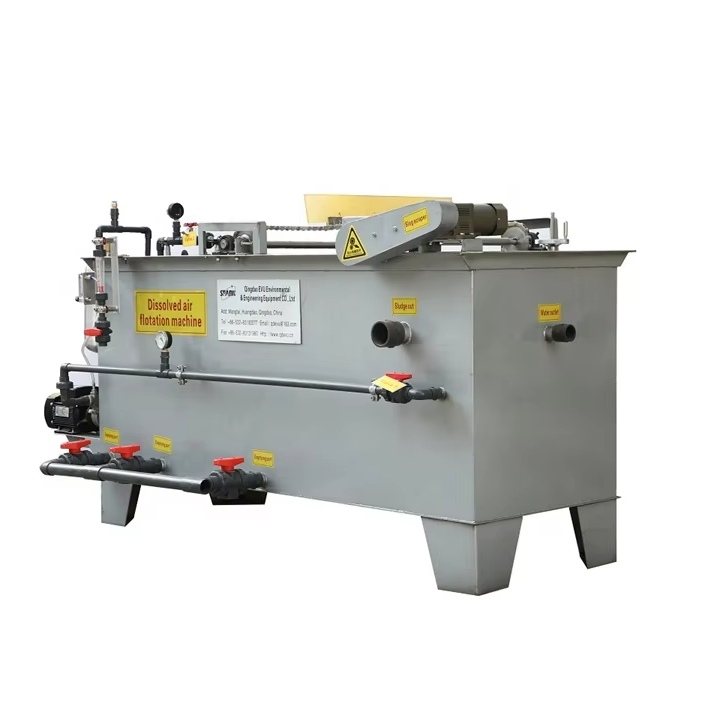
None of these technical and economic advantages mean anything if the machine itself is poorly built. A DAF system is not a simple concrete basin; it is a precision engineered assembly of pressure vessels, skimmer flights, and complex piping geometries. The difference between a theoretical rise rate and what is actually achieved in the field comes down to the quality of welding, the uniformity of bubble distribution, and the reliability of the surface skimming torque arm. When a manufacturer controls the entire supply chain from steel plate rolling to final assembly and wet testing, the risk of performance gaps disappears. QDEVU manages this integrated fabrication process, ensuring that every DAF unit leaving the factory floor embodies the high rate clarification principles that the engineering design intended. An operator inheriting a unit built with this level of supply chain oversight can trust that the sludge removal efficiency promised on paper will actually occur when the switch is thrown, supported by durable components that withstand years of continuous duty without premature failure.