 EN
EN
How Dissolved Air Flotation Machine: Mechanism and Core Principles
The Science of Microbubble Attachment in Contaminant Removal
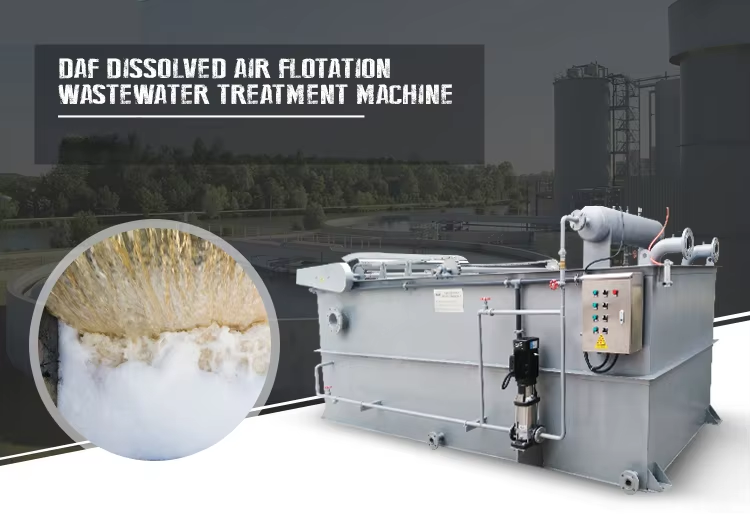
Dissolved Air Flotation or DAF systems work by using tiny air bubbles around 50 to 80 microns across to pull out stuff like dirt particles, oil, and grease from wastewater. When water under pressure gets loaded with air and then released quickly into the treatment tank, it creates that cloudy whitewater look everyone recognizes. The small bubbles float upward through the water column, sticking to contaminant as they go. This makes the contaminated material lighter than water so it floats to the top where operators can skim it off and get rid of it. The whole process works pretty well for cleaning industrial wastewater streams without needing too much energy.
To enhance this process, coagulants and flocculants are often added to aggregate fine particles into larger flocs (>100 µm), which improves bubble adhesion. In optimized conditions, DAF achieves 90–95% removal of total suspended solids (TSS), making it highly effective for industrial wastewater treatment.
Key Components of an Air Flotation Machine and Their Functions
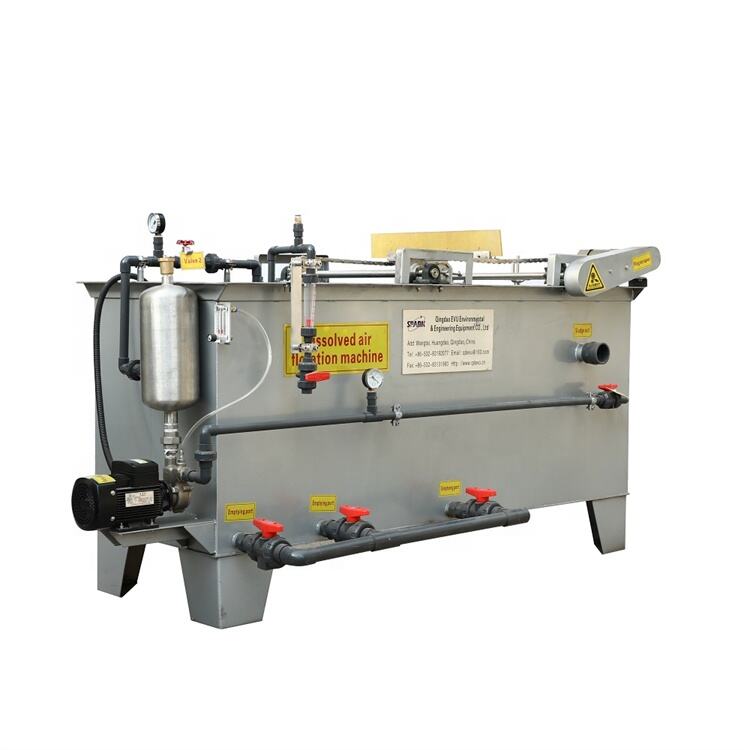
A typical DAF system consists of three main subsystems:
- Coagulation/Flocculation Chamber: Treats wastewater with chemicals to destabilize colloids and promote floc formation
- Pressure Vessel: Dissolves air into recycled effluent under 30–90 psig pressure
- Separation Tank: Provides reaction zones for bubble-particle interaction and clarification zones for floating sludge removal
Surface skimmers continuously remove the floated material, while advanced designs incorporate inclined plate settlers to boost separation efficiency by 15–20%.
Optimizing Pressure, Retention Time, and Bubble Generation for Peak Performance
Maximizing DAF efficiency depends on balancing three key parameters:
- Pressure: Operating at 40–60 psig optimizes bubble density without excessive energy use
- Retention Time: 15–30 minutes ensures complete contact between bubbles and particles
- Bubble Size Distribution: Maintaining bubbles between 70–100 µm through nozzle design enhances attachment
Modern systems employ automated controls to adjust chemical dosing with ±2% accuracy and regulate flow rates, ensuring consistent performance even under variable wastewater loads.
Superior Treatment Efficiency: DAF’s Performance in Removing TSS, BOD, COD, and Oils
High-rate separation of suspended solids, fats, oils, and greases
DAF systems are really good at taking out those suspended solids (TSS) and those pesky hydrophobic pollutants we call fats, oils, and greases (FOG). The technology works through microbubble attachment processes, which allows Air Flotation Machines to remove around 90% of TSS and cut down FOG levels by about 85% when used in industrial settings. What makes this approach stand out is how fast it actually works. Most DAF installations have retention times below 20 minutes, making them roughly five times quicker compared to traditional sedimentation methods. This speed advantage means facilities can install smaller units yet still handle large volumes of wastewater efficiently without compromising on performance.
Enhancing efficiency with coagulation, flocculation, and chemical dosing strategies
Integrating coagulation and flocculation significantly boosts DAF performance. Proper polymer dosing reduces particle zeta potential by 40–60 mV, promoting floc growth and improving bubble adherence. Facilities using ferric chloride with anionic polymers report 15–30% higher COD reduction compared to standalone DAF operation, demonstrating the value of chemical optimization.
Case Study: Achieving 95% TSS reduction in a pulp and paper mill using DAF
A North American pulp mill reduced pretreatment costs by 18% after installing a DAF system with automated chemical dosing. The system lowered influent TSS from 1,200 mg/L to 60 mg/L—a 95% reduction—while decreasing sludge volume by 35%. This case highlights DAF’s dual advantages in treatment effectiveness and waste minimization.
Widespread Industrial Applications of DAF Systems Across Key Sectors
DAF in Food and Beverage, Oil and Gas, and Textile Manufacturing
DAF systems tackle tough wastewater problems in all sorts of industrial settings. The food processing sector relies on them to get rid of those stubborn fats, oils, and greases FOG stuff with pretty impressive results around 95% effectiveness according to a recent study in the Wastewater Treatment Journal. Over at petroleum refineries, these systems help break down those tricky emulsified oil mixtures. Textile factories find them just as valuable for removing colorful dyes and all kinds of solid particles from their dye house waste streams. This keeps them within legal limits set by environmental regulations, which is becoming increasingly important as standards get tighter across the board.
Modular and Containerized Air Flotation Machine Solutions for Scalability and Remote Deployment
Pre-engineered, skid-mounted DAF units reduce installation time by 40–60% compared to traditional systems. Containerized configurations allow rapid deployment in remote settings such as offshore platforms, while modular designs support incremental capacity expansion without disrupting operations.
Case Study: Brewery Wastewater Treatment Using Advanced DAF Technology
A state-of-the-art compact Dissolved Air Flotation (DAF) system went live at a local craft brewery dealing with around 500 cubic meters per day of strong organic wastewater from their production line. By fine tuning the chemical additives and adjusting water flow rates, this setup managed to slash Chemical Oxygen Demand by nearly 90 percent while reducing sludge output by an impressive 85%. These improvements translated into real savings for the brewery owner who now spends about $120k less each year on waste disposal fees. What we see here isn't just another engineering success story but actual proof that modern DAF technology can deliver substantial benefits for businesses looking to improve their bottom line without compromising environmental standards.
Advantages Over Alternatives: DAF vs. Sedimentation, DGF, and Membrane Filtration
When it comes to wastewater treatment, Dissolved Air Flotation or DAF really stands out from traditional methods because it works faster, takes up less space, and adapts better to different situations. The system uses tiny air bubbles to separate solids from water, which means it can remove these particles about two to three times quicker than regular sedimentation tanks. Plus, facilities need only about 40 percent of the floor space that older systems require. Looking at another option called Dissolved Gas Flotation (DGF), there's a big difference in how much pressure each method needs to operate. While DGF runs at pressures between 80 and 100 psi, DAF manages with just 45 to 60 psi. According to research published by Water Environment Federation back in 2023, this pressure difference actually cuts down on energy usage somewhere around 25 to 30 percent. That makes a real impact over time for plant operators watching their utility bills.
Why DAF Outperforms Traditional Clarifiers and Other Flotation Methods
DAF can remove particles as small as 10 microns—well below the 50-micron threshold of most clarifiers. The bubble attachment mechanism enables 90–95% TSS removal, far exceeding the 60–75% typical of sedimentation. This makes DAF particularly effective for challenging wastewaters with fine or buoyant solids.
Cost, Space, and Efficiency Comparison with Membrane Filtration and Sedimentation
While membrane filtration delivers higher purity, DAF offers substantial cost advantages: 60% lower capital investment and 35% reduced operating expenses due to minimal fouling and no need for frequent membrane replacement. A standard Air Flotation Machine occupies 70% less space than equivalent-capacity sedimentation basins, facilitating retrofits in space-constrained facilities.
Trend: Hybrid Systems Combining DAF with Ultrafiltration for Water Reuse and Zero Liquid Discharge
Leading installations now pair DAF with ultrafiltration membranes to achieve >99% contaminant rejection while preventing membrane fouling. These hybrid systems recover 85–90% of treated water for reuse, supporting zero liquid discharge initiatives and meeting stringent regulations such as California’s Title 22 standards for recycled water.
Compact Design, Cost-Effectiveness, and Environmental Benefits of Modern DAF Units
Space-Saving Footprint of Air Flotation Machine in Urban and Retrofit Installations
DAF units today take up about half the space compared to old school clarifiers. Systems that process around 500 cubic meters per day actually need just 15 to 25 square meters of floor space. The smaller footprint means these can fit right into city locations or be added onto existing facilities without tearing everything apart. Take Barcelona for example they did a big upgrade last year and saved roughly 34 percent on engineering expenses simply by installing modular DAF units inside their already built concrete basins. Makes sense when looking at space constraints in urban areas.
Lifecycle Cost Savings Through Lower Maintenance, Sludge Volume, and Energy Use
DAF systems reduce operating costs by 18–27% compared to sedimentation (Water Environment Federation 2023), driven by:
- 56% lower sludge volumes due to higher solids concentration (6–8% vs. 2–3%)
- 30% energy savings from efficient bubble generation (0.3–0.5 kWh/m³)
- Twice the lifespan of mechanical components thanks to reduced abrasive wear
These efficiencies translate into long-term savings and lower lifecycle environmental impact.
Supporting Sustainability Goals: Water Reuse and Compliance With Environmental Regulations
DAF technology helps food processing sites recover around 75 to 85 percent of their water which can then be reused for things like irrigation systems or cooling processes. This means these facilities typically cut down on fresh water usage by approximately 2.8 million liters every year at each location. Most European Union industrial facilities that implement DAF systems are able to comply with the tough requirements set out in EU Directive 2020/741 regarding biochemical oxygen demand (BOD) below 10 mg/L and total suspended solids (TSS) under 15 mg/L standards. What's interesting is that many of them actually meet these targets without needing any extra tertiary treatments, making DAF an important tool for running businesses sustainably while staying within regulatory boundaries.
FAQ
- What is Dissolved Air Flotation (DAF)? DAF is a water treatment process that removes particles and pollutants using tiny air bubbles.
- How do DAF systems optimize wastewater treatment? DAF systems optimize treatment through pressure regulation, retention time management, and bubble size distribution.
- What industries benefit from DAF systems? Industries like food and beverage, oil and gas, and textile manufacturing benefit from DAF systems.
- What are the advantages of DAF over sedimentation and membrane filtration? DAF offers faster processing, lower energy use, reduced space needs, and substantial cost advantages.
Table of Contents
- How Dissolved Air Flotation Machine: Mechanism and Core Principles
- Superior Treatment Efficiency: DAF’s Performance in Removing TSS, BOD, COD, and Oils
- Widespread Industrial Applications of DAF Systems Across Key Sectors
- Advantages Over Alternatives: DAF vs. Sedimentation, DGF, and Membrane Filtration
- Compact Design, Cost-Effectiveness, and Environmental Benefits of Modern DAF Units
- FAQ