 EN
EN
How Dissolved Air Flotation Machine: Principles and Mechanisms
Core Principles of Air Flotation in Water Separation
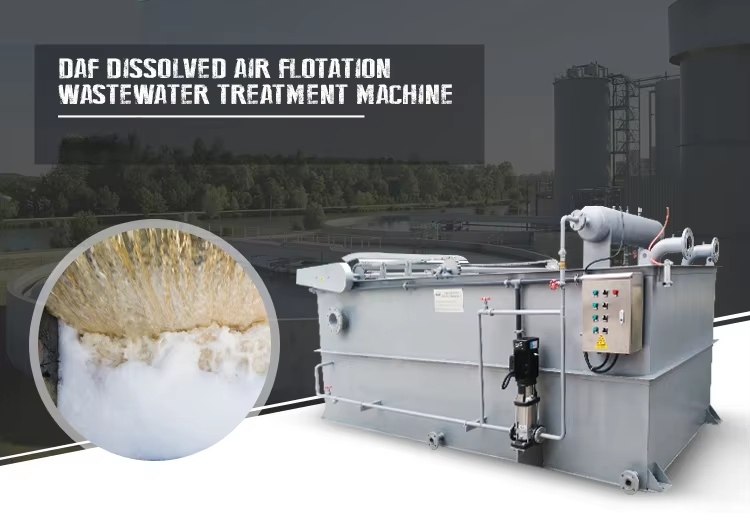
The Dissolved Air Flotation process, commonly called DAF, works by separating those pesky suspended solids and emulsified oils from wastewater through tiny air bubbles that float contaminants right to the top. What makes it different from regular gravity separation? Well, DAF actually dissolves compressed air into water under pressure, creating those super small bubbles around 40 to 70 microns in size. When released into the flotation tank, these microscopic bubbles stick to the particles they encounter. The science behind this involves both adsorption processes and charge neutralization effects, basically making the bubbles act like little magnets for impurities. As they rise together, they form what's known as a sludge blanket on the surface that operators can then skim off. There are two primary ways this system gets set up. One approach is recycle air injection at pressures between 30 and 90 psi, where air goes into a separate side stream to keep things calm inside the tank. The other method is full flow pressurization, injecting air straight into the incoming wastewater stream. Industry leaders have fine tuned both approaches over time, getting most systems to remove anywhere from 85% to almost 95% of oils and greases in real world industrial settings.
Microbubble Generation and Particle Attachment in DAF
Effective DAF performance depends on generating microbubbles that maximize contact with target particles. Saturation vessels dissolve air into water at 60-90 psi, releasing millions of bubbles when pressure drops in the flotation chamber. Bubble-particle attachment occurs through three mechanisms:
- Collision: Bumps between rising bubbles and suspended solids
- Adsorption: Charge attraction between bubbles and coagulant-treated particles
- Entrapment: Physical capture within floc structures
Optimized bubble size (50-80 µm) increases attachment rates by 25% compared to larger bubbles (>100 µm), enabling DAF systems to remove particles as small as 2-5 µm—three times more effective than traditional sedimentation.
Saturation, Nucleation, and Bubble Formation Process
DAF systems dissolve 8-12% air by volume through a three-stage process:
- Pressurization: Water-air mix enters a retention tank at 4-6 bar
- Nucleation: Pressure release triggers microbubble formation on impurities
- Growth: Bubbles expand to 70-120 µm during ascent
Maintaining 65-75 psi in the saturator improves bubble density by 18%, which is critical for treating high-load wastewater (≥800 mg/L TSS). This controlled nucleation outperforms dissolved gas flotation (DGF), which suffers from inconsistent bubble sizes above 150 µm.
Why DAF Outperforms Gravity-Based Sedimentation
| Parameter | DAF System | Gravity Clarifier | Improvement |
|---|---|---|---|
| Hydraulic Loading Rate | 4-12 gpm/ft² | 0.5-1.5 gpm/ft² | 8x |
| Footprint | 30-50 m² | 100-150 m² | 67% smaller |
| Fine Particle Removal | 95% (2-5 µm) | 40% (>20 µm) | 2.4x |
| Sludge Moisture | 92-94% | 96-98% | 50% drier |
By combining microbubble physics with optimized floc formation, DAF achieves 85% faster separation times than sedimentation, particularly for low-density particles like algae or oil droplets. Industry data confirms a 40% reduction in chemical usage versus induced gas flotation (IGF) systems when treating food processing wastewater.
Key Components of an Air Flotation Machine and System Design
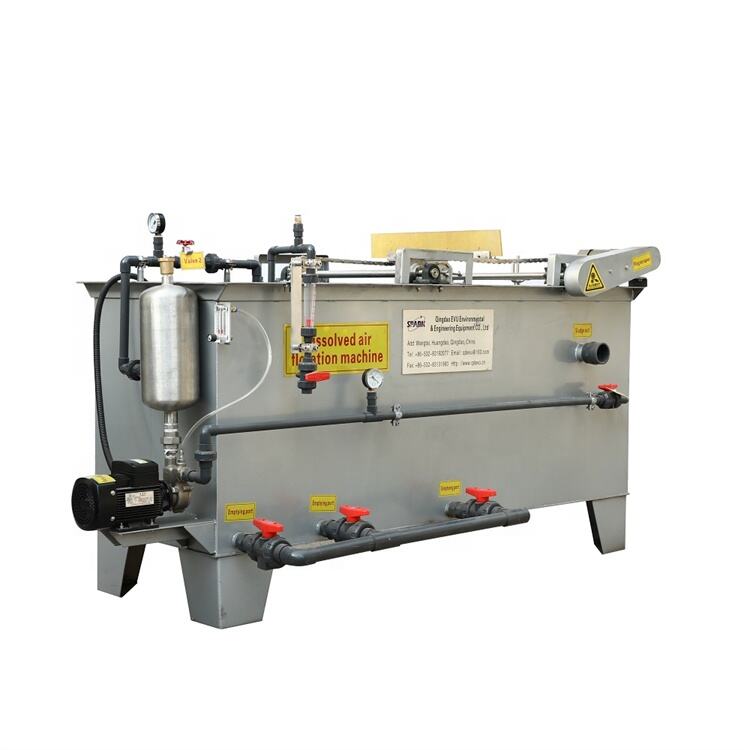
Effective air flotation systems rely on three critical components working in harmony: the flotation tank, air saturation unit, and skimmer system. Each plays a distinct role in achieving high particle removal rates while maintaining operational efficiency.
Flotation Tank Configuration and Hydraulic Loading
How a flotation tank is shaped really affects how much water it can handle at once, which is basically what we call hydraulic loading rates. Tanks that are either rectangular or round work best when baffles are placed just right, creating smooth water movement instead of all that messy turbulence that messes up the sludge layer on top. Most folks in the business stick to guidelines suggesting somewhere around 3 to 5 gallons per minute per square foot for these loading rates. This sweet spot keeps things moving through the system while still getting good separation results. If operators push beyond those numbers though, they run into problems fast. The tiny air bubbles start breaking down too soon, and suddenly the system isn't removing nearly as many suspended particles from the water as it should be. Some tests show removal rates drop by about a quarter when this happens.
Air Saturation Unit: Maximizing Saturator Efficiency
Pressurized air saturation units dissolve air into water at 50-70 psi, creating microbubbles 30-50 µm in diameter—ideal for attaching to hydrophobic particles. Advanced saturators maintain 70-80% air dissolution efficiency through multi-stage recirculation, a 200% improvement over single-pass designs. Temperatures below 25°C further enhance bubble stability, preventing coalescence during flotation.
Skimmer Systems and Effective Sludge Removal
Adjustable-speed skimmer blades remove floated sludge layers with 95-98% moisture content, helping reduce downstream dewatering costs. Synchronized paddle rotation (2-5 rpm) ensures continuous removal without disturbing the treated effluent. Dual skimmers with variable pitch angles achieve 18% higher sludge capture rates compared to single-blade configurations.
By optimizing these components, modern air flotation machines achieve 90-95% TSS removal across industries—a 35% efficiency gain over traditional gravity clarifiers in high-turbidity applications.
Chemical Pretreatment: Coagulation, Flocculation, and Floc Optimization
Role of Coagulants and Flocculants in DAF Performance
When coagulants get to work, they basically cancel out those pesky electrical charges hanging around suspended particles. This breaks down the stability of colloidal suspensions and gets things started toward forming those tiny flocs we all know and love. The old standbys like aluminum sulfate (commonly called alum) and ferric chloride have been going strong for ages as inorganic options that grab onto fine solids through this charge neutralization process. Once those microflocs start forming, it's time for flocculants to step in. These synthetic polymers act like little bridges connecting all those small flocs together into bigger clumps, which makes them float better during treatment. Some folks are turning to natural alternatives made from plant extracts these days too. They actually remove particles at similar rates (around 85 to 92 percent) but leave behind about 30 percent less sludge compared to traditional methods. Most of these coagulant products work best when the water has a pH somewhere between 5.4 and 7.4. Cold weather? Not so good for reactions here since lower temps just make everything move slower, which isn't great if efficiency matters.
How Floc Size Influences Particle-Bubble Attachment
The size of flocs plays a major role in how well DAF systems work. When particles are between about 10 to 100 microns, they attach to microbubbles around 70 percent better because there's just more chance for them to bump into each other on the surface. But when flocs get too big, say over 500 microns, they don't float as nicely and tend to fall apart when the system gets stressed hydraulically. That's why operators need to find the sweet spot with their mixing speed and coagulant amounts so the flocs stay in that goldilocks zone of 50 to 300 microns. Getting this right means most plants can knock out about 95% of oils and greases from their wastewater streams. Many facilities now use real time turbidity checks to tweak flocculant doses on the fly, which helps keep things running smoothly even when the incoming water changes day to day.
Refining pretreatment chemistry maximizes air flotation machine performance while minimizing chemical consumption and operational costs.
DAF Process Operation: From Influent to Effluent Optimization
Step-by-Step Flow of the DAF Wastewater Treatment Process
DAF starts off with screening the incoming water to get rid of big stuff floating around. After that comes some chemical treatment where special chemicals called coagulants grab onto those tiny particles we can't see. Once this treated water goes into the air flotation unit, what happens next is pretty interesting. Pressurized air gets dissolved in there and creates these super small bubbles, about 20 to 50 microns across, which stick to all sorts of suspended matter in the water. These little bubble clusters then float up to the surface. A mechanical device called a skimmer sweeps away the sludge that builds up on top while the cleaned water flows out from underneath through specially designed weirs at the bottom of the tank. When everything works right, these improved DAF systems manage to cut down suspended solids by roughly 40 percent when compared against older traditional approaches.
Optimizing Hydraulic Loading and Air-to-Solids Ratio
The main things that affect how well these systems work are the hydraulic loading rates, which usually fall between 2 and 5 gallons per minute per square foot, plus the air-to-solids ratio. When there's too much water flowing through, it actually breaks apart those important bubble-particle attachments. On the flip side, if the A/S ratio drops below 0.01 mg-air per mg-solids, we end up with poor flotation results. Modern installations have started incorporating real time turbidity monitoring equipment that automatically adjusts air injection levels, keeping the A/S ratio right around 0.03 to 0.06. What does this mean practically? Well, operators report saving about a quarter of their energy costs while still getting water clarity down to under 10 NTUs in most cases.
Industrial Applications of Air Flotation Machines
DAF in Food Processing and Industrial Wastewater Treatment
Air flotation machines work really well for treating food processing wastewater, getting rid of those pesky fats, oils, and suspended solids (FOG) that come out of meatpacking plants, dairies, and breweries. When it comes to poultry processing specifically, dissolved air flotation systems can cut down biochemical oxygen demand (BOD) by somewhere between 40 and 60 percent. This happens because tiny bubbles stick to the fat particles and float them to the surface. Beyond just food industries, these systems find their way into chemical manufacturing too. There they help separate out tricky substances like emulsified hydrocarbons and heavy metals, even when water flows through at impressive speeds over 500 gallons per minute. Makes sense why so many factories rely on this technology.
Expanding Use of DAF in Municipal and Drinking Water Plants
Water treatment plants across the country are starting to install these air flotation devices when dealing with those pesky algae blooms and other light particles that just won't settle down normally. According to the latest EPA report from 2024 on drinking water standards, dissolved air flotation systems actually remove around 92% of turbidity from surface waters, which beats traditional sand filters by almost 20 percentage points. Some pretty interesting new developments are happening too. These machines can now catch microplastics in recycled water systems as well. Early tests at pilot plants show they're getting rid of about 85% of microplastics when operators fine tune the coagulants and get the right balance between air bubbles and solid material.
FAQ
What is Dissolved Air Flotation (DAF)?
DAF is a water treatment process that involves dissolving air into water under pressure to create tiny air bubbles. These bubbles attach to suspended solids, oils, and other contaminants, causing them to float to the surface where they can be removed.
How does DAF differ from traditional sedimentation?
DAF differs from traditional sedimentation by using microscopic air bubbles to achieve separation, rather than relying solely on gravity. This makes it highly effective for removing fine particles, oils, and greases.
Where is DAF used?
DAF is used in various industries, including food processing, chemical manufacturing, and municipal water treatment plants. It is effective in treating industrial wastewater, removing fats, oils, greases, and even microplastics.
What are the benefits of using DAF?
DAF systems offer faster separation times, efficient removal of fine particles, reduced chemical usage, smaller footprint, and increased energy savings compared to other methods.
Table of Contents
- How Dissolved Air Flotation Machine: Principles and Mechanisms
- Key Components of an Air Flotation Machine and System Design
- Chemical Pretreatment: Coagulation, Flocculation, and Floc Optimization
- DAF Process Operation: From Influent to Effluent Optimization
- Industrial Applications of Air Flotation Machines
- FAQ