The ECDAF Electrocoagulation Flotation Machine integrates electrochemistry and dissolved air flotation into high-efficiency solid-liquid separation equipment. Its operating principle consists of three core processes as detailed below: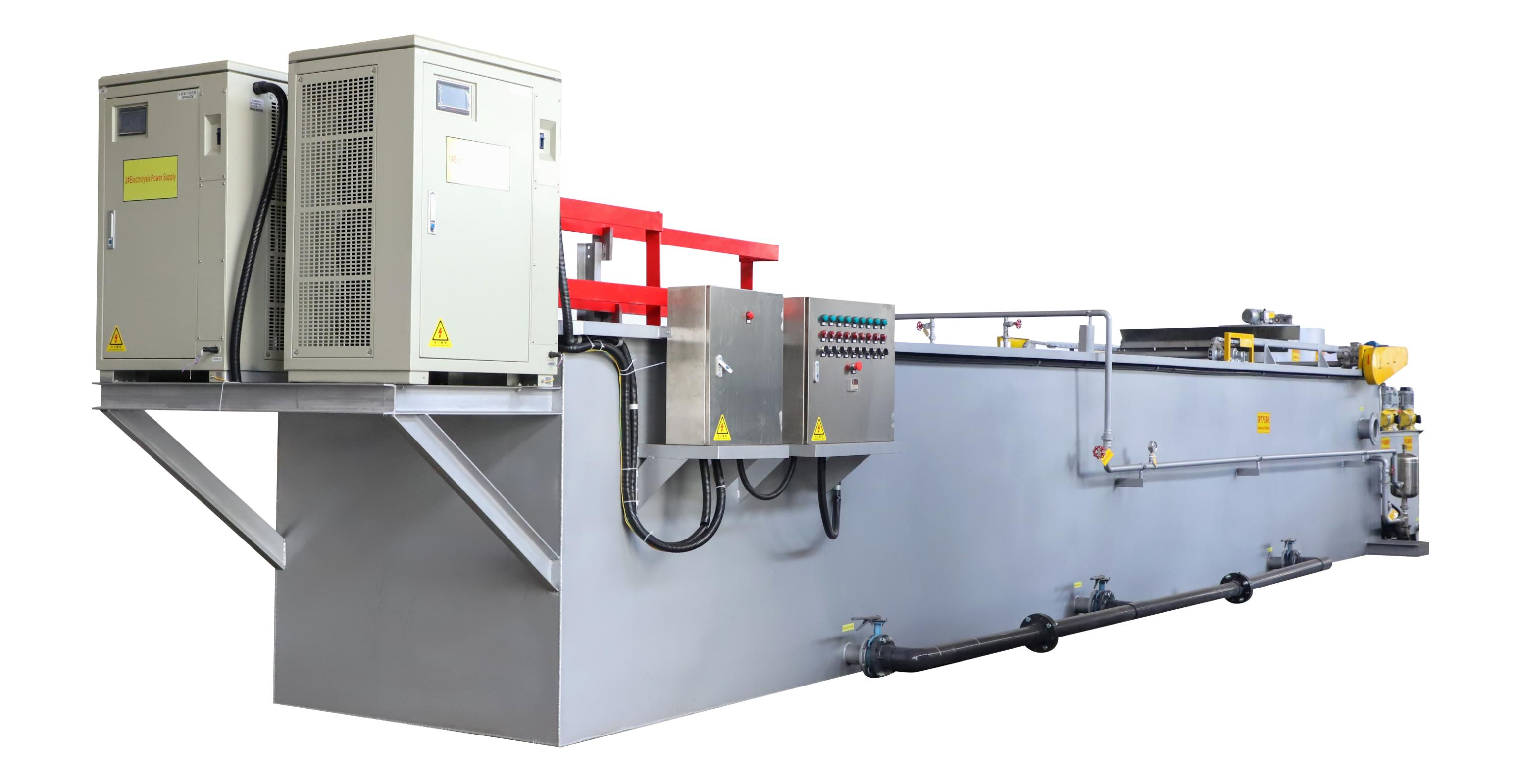
Direct current is applied to wastewater via an external power supply, prompting the dissolution of soluble anodes (normally iron or aluminium) to release highly active metal ions. These ions undergo in-situ hydrolysis to form diverse polynuclear hydroxyl complexes and metal hydroxides. The resultant flocculants neutralise negative charges carried by suspended solids, colloidal particles and emulsified oil droplets in wastewater, destabilising their uniform dispersion in aqueous phase.
Different from conventional air flotation devices equipped with auxiliary air-dissolving systems, this equipment produces abundant fine hydrogen microbubbles (20–60 μm in diameter) at cathodes through water electrolysis. Featuring ultra-fine particle size, large specific surface area and low rising velocity, such microbubbles lay favourable foundations for subsequent adhesion and separation.
Fine microbubbles collide and adhere rapidly with destabilised flocs to form bubble-floc aggregates with bulk density lower than water. Driven by buoyancy, these aggregates float upward to the water surface and accumulate into stable scum layers, which are mechanically scraped off automatically by a scum scraper to complete efficient separation of clean water from contaminants.
The equipment eliminates the need for additional chemical coagulant dosing and delivers stable, uniform bubble generation. It is widely applicable for removal of emulsified oil, fine suspended solids and refractory organic pollutants.
 EN
EN

 Hot News